
RIAM SYMPOSIUM 2026 (press to enter the website)
Educating Through Care: Music, the Arts and the Social Value of Cultural Education in Contemporary Societies
22 & 23 May 2026
Department of Pre-School Education & Educational Design, School of Humanities, University of The Aegean
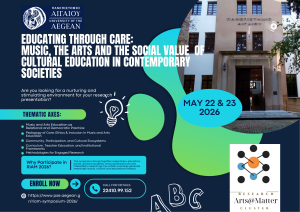
The RIAM 2026 Organizing Committee invites researchers, educators, artists, practitioners, and policymakers to submit proposals that engage critically, reflectively, and constructively with the theme: Educating Through Care: Music, the Arts, and the Social Value of Cultural Education in Contemporary Societies. RIAM 2026 builds on the interdisciplinary, innovative, and research-driven foundations of RIAM 2025, advancing the discussion toward the social responsibility, ethical grounding, and public value of music and arts education. The conference foregrounds care-informed perspectives that recognize education for culture as a relational, emotional, and socially embedded practice with demonstrable impact on individuals, communities, and institutions. We welcome theoretical, empirical, methodological, and practice-based contributions that explore how music and the arts function as educational practices of care, inclusion, participation, and social benefit across formal, non-formal, and informal contexts, and across all levels of education. The RIAM 2026 Organizing Committee explicitly welcomes contributions focusing on primary and secondary education, recognizing schools as central spaces where the pedagogy of care, inclusion, and social responsibility is enacted daily through music and the arts.
1️⃣ Keynote speakers
2️⃣ Review Committee
Why Participate in RIAM 2026?
The RIAM Symposium 2026—Research Impact of Arts@Matter, hosted by the University of the Aegean in Rhodes, provides a unique international forum for exploring the transformative role of the arts in education, culture, and society. The symposium brings together researchers, educators, artists, doctoral students, and practitioners who are interested in examining how artistic practices generate meaningful social, cultural, and educational impact. Interdisciplinary Dialogue: RIAM 2026 fosters dialogue across disciplines, including arts education, music education, cultural studies, creative practices, social innovation, and digital culture. Participants will have the opportunity to exchange ideas, present research, and engage in discussions that highlight the ways artistic practices contribute to contemporary educational and societal challenges.
International Academic Exchange: The symposium welcomes contributions from scholars and practitioners from different countries and institutional contexts. By encouraging international collaboration, RIAM 2026 promotes the development of new research networks and interdisciplinary partnerships that strengthen the global dialogue on arts-based research and education.
Publication Opportunities: Participants will have the opportunity to publish their accepted papers in the conference proceedings, which will include DOI assignment and editorial processing. This provides an opportunity for researchers to disseminate their work within an international academic community.
Hybrid Participation: RIAM 2026 offers both on-site and online participation, allowing scholars from around the world to participate in the symposium regardless of location. This hybrid format promotes inclusive academic participation and expands the reach of the symposium’s discussions.
Academic and Cultural Experience in Rhodes: The symposium will take place on the island of Rhodes, home to the University of the Aegean and a site of rich historical and cultural heritage. Participants attending on-site will experience an inspiring academic environment where research, culture, and dialogue intersect within one of the Mediterranean’s most historically significant locations.
You are warmly invited to contribute to RIAM Symposium 2026 and to participate in an international dialogue on the role of the arts in shaping educational innovation, cultural understanding, and social transformation.
Call for papers & Thematic Axes: Submissions may address, but are not limited to, the following: Contributions that bridge research and practice or include reflective accounts grounded in empirical or action research are particularly encouraged. Across all thematic areas, RIAM 2026 encourages contributions that critically engage with issues of care, vulnerability, and social responsibility as relational and context-sensitive dimensions of music and arts education.
All RIAM 2026 symposium proposals will be double-blind peer-reviewed. Accepted contributions can be further developed into chapter proposals for a peer-reviewed edited volume. You can present either on-site in Rhodes or online. All submission formats are available to all participants.
Submission Guidelines: Researchers, educators, artists, and practitioners are invited to submit proposals aligned with the thematic orientation of RIAM 2026.
Types of submissions
- Spoken paper (theoretical): 15 minutes.
- Research papers (empirical, methodological, action research, and reflective practitioner studies): 15 minutes.
- Poster: Both printed and digital posters are welcome.
- Panel: We recommend including four to six panel members representing both researchers and practitioners. Session length: 90 minutes.
- Workshops and collaborative sessions: Session length: 90 minutes.
Language: Presentations will be delivered in English; Greek submissions may be accommodated in specific sessions.
Abstract submission deadline: 20 April 2026
Contact Information: Dr. Maria Argyriou, Applied Music Pedagogy, International Symposium Chair, RIAM 2026 Symposium, Department of Pre-School Education & Educational Design, School of Humanities, University of The Aegean (m.argyriou@aegean.gr)
Registration: Participation in the RIAM Symposium 2026—Research Impact of Arts@matter is possible either on-site in Rhodes or online, allowing participants from different parts of the world to engage in the symposium’s interdisciplinary discussions. The symposium brings together researchers, educators, artists, and practitioners working across the fields of arts education, cultural studies, and social innovation. Through presentations, discussions, and collaborative sessions, the event aims to explore the social, educational, and cultural impact of artistic practices in contemporary societies.
Participation fee: Participation in the symposium (online or on-site) is free of charge.
Proceedings publication fee: Authors who wish to publish their accepted paper in the conference proceedings are required to pay a publication fee of 80 € per paper. The publication fee covers editorial processing of the manuscript, DOI assignment, and publication in the conference proceedings. Publication in the proceedings is optional, and all submitted papers will undergo peer review. The author(s) of each accepted paper must register for the paper to be included in the conference program and proceedings.
Music and Arts Education in Primary & Secondary Schools
Educating Through Care in Everyday School Practice
A shared space for dialogue
RIAM 2026 aims to create a supportive and respectful environment where teachers, researchers, and artists can learn from one another, bridging theory and everyday educational practice through a shared commitment to educating through care. RIAM 2026 warmly invites music teachers, arts educators, and interdisciplinary school teachers from Primary and Secondary Education to contribute to the conference. We recognise that schools are among the most important spaces where care, inclusion, and social responsibility are enacted daily. Music and the arts often function as safe spaces for expression, connection, and belonging, especially for students experiencing vulnerability, exclusion, or emotional challenges. You do not need to present a “traditional academic paper”. What matters is: clear reflection, connection to educational aims, and evidence of care-informed practice. This special call welcomes teacher-led contributions that demonstrate how music and arts education: supports student well-being and emotional safety, fosters inclusive and caring classroom environments, strengthens school community and student voice and contributes to the social role of the school.
What kinds of contributions are welcome?
Teachers are encouraged to submit:
- Case studies from their classrooms or schools
- Action research projects (even small-scale)
- Reflective accounts of innovative or caring practices
- Interdisciplinary school projects involving music and the arts
- Collaborations with communities, cultural institutions, or families
Why your contribution matters (research-informed perspective)
Contemporary research in music and arts education consistently demonstrates that learning is a deeply relational and emotional process, rather than a solely cognitive one. Care-based pedagogical approaches have been shown to enhance student engagement, participation, inclusion, and well-being, particularly within diverse and socially complex school environments. Within this framework, reflective teaching practice is increasingly recognised as a valid and valuable form of educational knowledge, capable of generating insight into how cultural education operates in real contexts. RIAM 2026 therefore values school teachers not only as practitioners, but as knowledge producers, whose situated experiences and reflective accounts are essential for understanding the real social impact of music and arts education in schools.
Suggested Focus Areas for Teachers
- Music and arts as tools for emotional expression and student well-being
- Building trust and supportive teacher–student relationships through artistic practice
- Arts-based approaches to inclusion, diversity, and equity
- Trauma-informed practices in music and arts classrooms
- Strengthening school culture and belonging through collective artistic projects
- Partnerships between schools and local communities or cultural organisations
- Reflecting on challenges, limitations, and ethical questions in practice
Supportive Submission Format for Teachers
Abstract length: 250–400 words
Language: Greek/English (simple, clear academic or professional language is welcome)
Teachers may co-author with colleagues or researchers if they wish.